If you saw our “Treatment Tuesday” post on social media, you caught a quick view of a core safety setup we use on jobs across the Jersey Shore and South Jersey. Here’s what you’re seeing—and why it matters for your home or business in Toms River, Brick, to Freehold, Asbury Park, Long Branch, down to Atlantic City, Ocean City, Vineland, and Cape May.
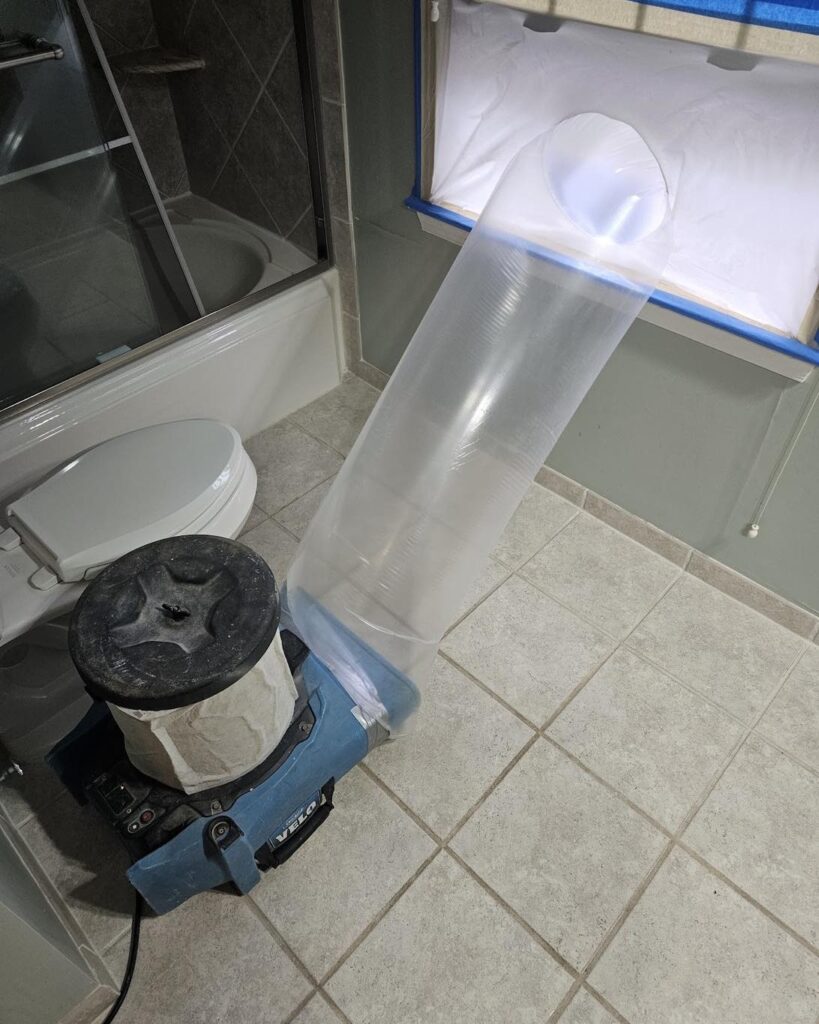
What’s in the photo
Blue machine (air scrubber/negative air machine): A professional air filtration device (AFD) designed for remediation work. When it recirculates air through a filter, it’s used as an air scrubber; when it exhausts air outdoors to create pressure lower than surrounding areas, it functions as a negative air machine.
White cylinder on top: A HEPA filter that captures very small particles (including mold spores and fine dust) before air is exhausted.
Clear plastic ducting to the window: Moves filtered air outside the work area.
Plastic & tape around the window: Seals the opening to maintain negative pressure so air flows out—not back into clean areas. EPA guidance calls for containment and negative pressure to prevent spore movement during remediation.
Why Negative Pressure and HEPA Filtration Are Essential
1) They help prevent cross-contamination
During mold cleanup, disturbing moldy or contaminated materials can aerosolize particles. Containment + negative pressure keeps those particles from drifting into hallways, bedrooms, or HVAC returns. EPA training materials are explicit: use polyethylene sheeting, airlocks, and fans/AFDs to create negative pressure so contaminants don’t escape the work zone.
2) They remove airborne spores and particulates
HEPA filtration can significantly reduce airborne mold spore levels during and after work. CDC/NIOSH ventilation guidance recommends portable HEPA fan/filtration systems to enhance air cleaning in higher-risk spaces, which is exactly how professional AFDs are deployed on remediation jobs.
3) They align with industry standards
The IICRC S520 (the industry’s consensus standard for mold remediation) defines and distinguishes air scrubbers and negative air machines, reinforcing their role in safe, professional containment. Using an AFD with HEPA filters to maintain negative pressure is part of best practice—not an optional extra.
Why You Shouldn’t DIY Mold or Biohazard Cleanup Without This Setup
- Mold work without containment spreads spores. EPA’s remediation guidance stresses containment and HEPA controls to avoid moving contamination to clean rooms or ductwork. Skipping this step can make the problem bigger and more expensive.
- Biohazard cleanup requires regulated controls and PPE. OSHA’s Bloodborne Pathogens Standard (29 CFR 1910.1030) requires employers (and by extension professional teams) to use engineering controls, PPE, exposure control plans, and proper decontamination for blood or other potentially infectious materials. Negative air and sealed containment are part of those engineering controls to limit exposure and spread.
- Health & safety first. CDC notes that mold cleanup—especially after water damage—carries health risks and should be performed with appropriate protection and safe methods. Professional teams bring the equipment, protocols, and training to do it safely.
What MasterTech Is Doing in the Photo
- Sealed Containment: The window opening is sealed in plastic. Doors, vents, and seams are similarly sealed inside the work area to stop migration of spores or bioaerosols.
- HEPA AFD Running to Negative: The unit draws air from the work zone, pushes it through a HEPA stack, and exhausts outdoors via the clear duct. That steady outward flow maintains negative pressure—air flows into the work area, never out.
- Best-Practice Workflow: Source control (fix moisture or remove the biohazard), containment, HEPA air filtration, and thorough cleaning per EPA/IICRC guidance. Where materials are unsalvageable, they’re bagged and removed inside containment, with HEPA vacuuming of surfaces after drying.
Negative pressure and HEPA filtration are non-negotiable for safe, effective mold or biohazard cleanup. They help protect your family, your employees, and your building by preventing cross-contamination and keeping the work zone controlled—exactly as recommended by EPA, CDC/NIOSH, IICRC, and OSHA.
Need Help Now?
If you suspect mold, water damage, or a biohazard situation, don’t DIY. Call MasterTech Environmental Jersey Shore for certified inspection, containment, and remediation done right. We’re local, trained, and fully equipped to protect your property—and everyone in it.